
Excessive Daytime Sleepiness in Kids: Why Does My Child Wake Up Tired Every Morning?

Updated: Aug 12
Your child went to bed at a reasonable time. They were in bed for eight, nine, or even ten hours. Yet when morning arrives, they are exhausted, irritable, and nearly impossible to wake. Sound familiar?
Occasional grogginess is normal, especially after a late night, a busy weekend, an illness, or a change in routine. But when your child regularly wakes up tired, or struggles with excessive daytime sleepiness, mood changes, or poor concentration throughout the day, it may be a sign that something is interfering with their sleep.

Sleep is not simply downtime. While children sleep, their brains process information, their bodies grow and recover, and the systems that regulate attention, memory, emotions, and immune health complete important work. A child can spend plenty of time in bed and still miss the deep, restorative sleep their body needs.
Understanding the possible reasons behind morning fatigue can help you determine whether your child needs a better routine, a conversation with their pediatrician, or a comprehensive pediatric sleep evaluation.
Is It Normal for a Child to Wake Up Tired?
Most children will have a difficult morning occasionally. They may have stayed awake reading, spent too much time on a device, worried about a test, or simply had a restless night. Consistent exhaustion and daytime sleepiness, however, is different.
A child who regularly wakes up tired may struggle to get out of bed, complain of headaches, fall asleep in the car, or seem unusually irritable before school. Some children do not appear sleepy at all. Instead, they become hyperactive, impulsive, emotional, or unable to concentrate.
Adults who are sleep-deprived often become quiet and sluggish. Children frequently react in the opposite way: they speed up.
This means that excessive daytime sleepiness in children can be mistaken for a behavior problem, a lack of motivation, or even symptoms of ADHD. While not every tired or hyperactive child has a sleep disorder, persistent changes in energy, attention, and behavior deserve a closer look.
Excessive Daytime Sleepiness Causes in Children Parents Should Know
There is no single explanation for why a child wakes up tired. The cause may be as simple as an inconsistent bedtime or as complex as an underlying sleep disorder.
Here are several possibilities to consider.
1. Your Child Is Not Getting Enough Sleep
The first question is not simply, “What time does my child go to bed?” It is, “How much time is my child actually sleeping?”
Time in bed and time asleep are not always the same. A child may go to their room at 9 p.m. but remain awake reading, watching videos, texting friends, or trying to fall asleep for another hour.
Sleep needs also change with age. According to recommendations supported by the American Academy of Sleep Medicine, children ages 6–12 generally need 9–12 hours of sleep per 24 hours, while teenagers ages 13–18 generally need 8–10 hours. Younger children typically need even more.
Early school start times, homework, sports, activities, and social schedules can quietly reduce a child’s total sleep. Even losing 30–60 minutes each night can add up over the course of a week.
Try tracking your child’s actual sleep for one or two weeks. Record when the lights go out, approximately when your child falls asleep, nighttime awakenings, wake time, naps, and how they behave the next day.
2. Their Sleep Schedule Is Inconsistent
Children’s bodies thrive on predictable routines. When bedtime and wake time change significantly from one day to the next, the body’s internal clock can become misaligned.
For example, a child may wake at 6:30 a.m. for school during the week but sleep until 11 a.m. on weekends. Sleeping late may feel like catching up, but large schedule shifts can make Sunday night sleep difficult and Monday morning especially painful.
Teenagers are particularly vulnerable because puberty naturally shifts their internal clocks later. A teen may not feel sleepy until late at night, even though school still requires an early wake time.
Keeping bedtime and wake time reasonably consistent, including on weekends, can help stabilize the sleep-wake cycle.
3. Screens Are Delaying Sleep
Phones, tablets, televisions, video games, and computers can interfere with sleep in more than one way. Evening light exposure can delay the body’s natural sleep signals. Engaging videos, games, group chats, and social media can also keep the brain alert long after the device is turned off. Notifications during the night may interrupt sleep, even when a child does not fully remember waking up.
Consider creating a family charging station outside the bedroom and turning off screens at least an hour before bedtime. A calm routine involving a bath, quiet conversation, stretching, or reading a printed book can help the brain transition toward sleep.
No one loves surrendering a phone at bedtime, of course. That conversation may require the diplomatic skill of an international peace summit, but the sleep benefits can be worth it.
4. Your Child May Have Sleep Apnea
Pediatric obstructive sleep apnea occurs when a child’s airway repeatedly becomes narrowed or blocked during sleep. These interruptions can disrupt normal sleep cycles and affect oxygen levels, preventing the child from getting restorative rest.
Signs may include:
Frequent or loud snoring
Pauses in breathing
Gasping, choking, or snorting during sleep
Mouth breathing
Restless or sweaty sleep
Sleeping with the neck extended or in unusual positions
Bedwetting beyond the expected age
Morning headaches
Difficulty waking up
Daytime sleepiness, hyperactivity, or poor concentration
Enlarged tonsils or adenoids are common contributors, but allergies, chronic nasal congestion, facial or jaw development, weight, and other health factors may also play a role.
The National Heart, Lung, and Blood Institute notes that childhood sleep apnea can affect behavior, learning, memory, school performance, and physical activity. If your child snores regularly or you notice breathing pauses, those symptoms should be discussed with a healthcare provider.
5. Restless Legs or Periodic Limb Movements Are Disrupting Sleep
Some children experience uncomfortable sensations in their legs when they are resting. They may describe the feeling as crawling, tingling, itching, buzzing, or an irresistible need to move.
Restless legs syndrome can make it difficult to fall asleep. Periodic limb movements can cause repeated kicking or jerking during sleep, sometimes without the child realizing it. Either problem may fragment sleep and leave a child tired the next morning.
Children may not have the language to explain what they are feeling. Instead, they may resist bedtime, constantly reposition themselves, kick the covers off, or say that their legs “feel funny.”
Low iron stores can be associated with restless legs symptoms in some children. A healthcare provider can determine whether testing is appropriate. Parents should not begin iron supplements without medical guidance, as too much iron can be dangerous.
6. Insomnia, Anxiety, or Stress May Be Keeping Their Brain Awake
Children can experience insomnia just as adults do. They may have trouble falling asleep, wake repeatedly, or wake too early and struggle to return to sleep.
Stress and anxiety can also make sleep difficult. School pressure, bullying, family changes, social concerns, frightening media, or worries about the next day may become louder when the bedroom becomes quiet.
Younger children may ask for repeated drinks, bathroom trips, or reassurance. Older children and teens may stay on their phones because distraction feels easier than lying awake with their thoughts.
A calming routine and consistent limits may help, but persistent insomnia or anxiety should be discussed with an appropriate healthcare professional.
7. Allergies, Asthma, Reflux, or Other Medical Issues May Be Interfering
Not every tired child has a primary sleep disorder. Nasal congestion, asthma symptoms, chronic pain, reflux, eczema, seizures, anemia, thyroid conditions, infections, and other medical concerns can interfere with sleep or cause fatigue.
Certain medications may also contribute to drowsiness or disrupted sleep. These can include some allergy medicines, seizure medicines, mood-related medications, and other prescriptions or over-the-counter products.
Do not stop a medication without speaking to your child’s healthcare provider. Instead, share your observations and ask whether the medication, dosage, or timing could be affecting sleep.
8. A Less Common Sleep Disorder Could Be Present
Persistent and severe daytime sleepiness can occasionally be related to a neurological sleep disorder, such as narcolepsy.
A child with narcolepsy may have overwhelming sleepiness, fall asleep unintentionally, or experience sudden muscle weakness triggered by strong emotions—a symptom called cataplexy. Other possible signs include vivid dream-like experiences when falling asleep or waking and temporary inability to move during those transitions.
Narcolepsy is not the most common explanation for childhood fatigue, but it is important to evaluate excessive sleepiness that does not improve with adequate sleep and a healthy schedule.
What Does Excessive Daytime Sleepiness Look Like in Children?
Excessive sleepiness is not always obvious. Watch for patterns such as:
Falling asleep during class, homework, meals, or short car rides
Needing frequent naps beyond the expected age
Being extremely difficult to wake
Sleeping much longer on weekends
Frequent tardiness or missed school
Declining grades or difficulty remembering information
Hyperactivity or impulsive behavior
Irritability, emotional outbursts, or mood changes
Morning headaches
Low motivation or reduced interest in activities
Increased caffeine use in older children and teens
If these symptoms are frequent, interfere with daily life, or continue despite adequate sleep time, it may be time to look beyond bedtime habits.
What Parents Can Try at Home
Healthy sleep habits cannot cure every sleep disorder, but they create a strong foundation and can provide useful information about whether the problem improves.
Try these steps:
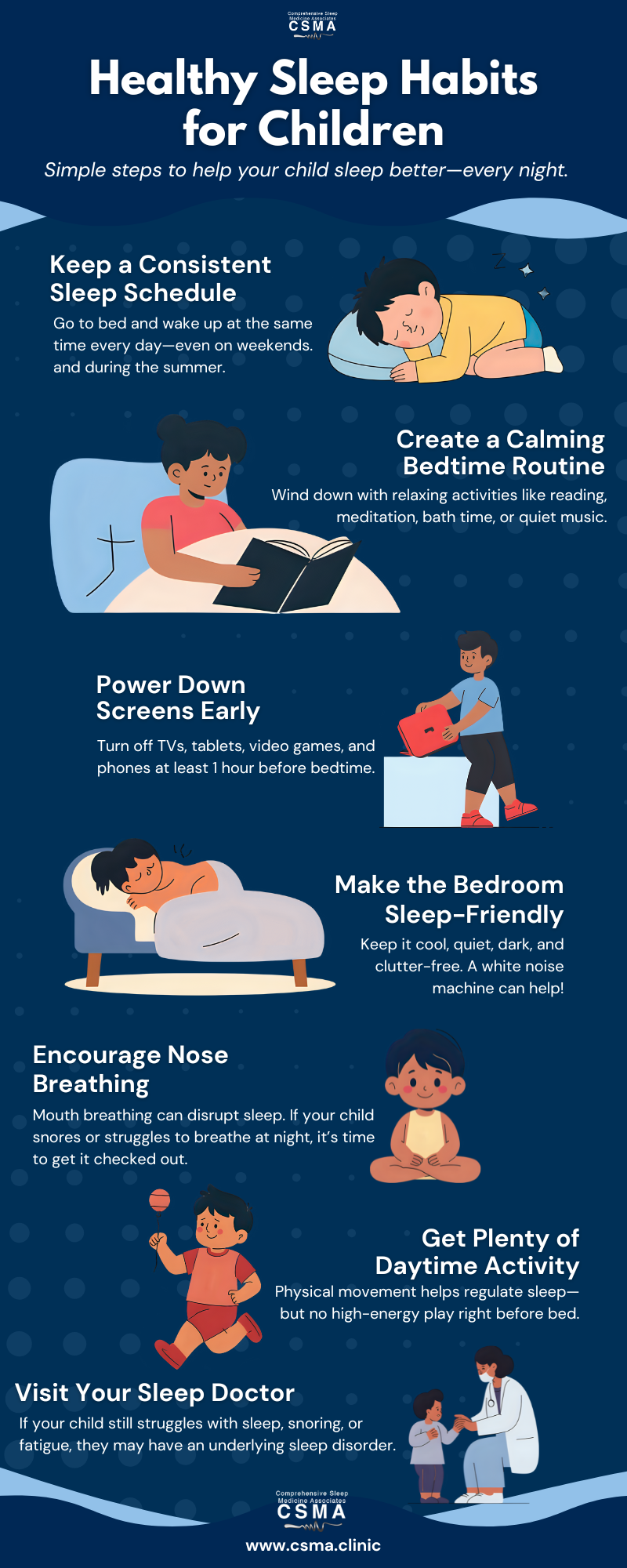
Set a consistent sleep schedule. Keep bedtime and wake time similar each day.
Allow enough time for sleep. Work backward from the required morning wake time.
Create a predictable bedtime routine. Choose calm activities and follow the same sequence nightly.
Remove screens from the bedroom. Charge devices in a shared space.
Watch caffeine intake. Soda, coffee, tea, chocolate, energy drinks, and some supplements may contain caffeine.
Encourage daytime activity. Regular movement and exposure to morning light support healthy sleep rhythms.
Keep the bedroom comfortable. A quiet, dark, cool room usually supports better sleep.
Document concerning symptoms. A sleep diary—and, when safe, a brief recording of unusual snoring or breathing—may help your child’s provider understand what is happening.
If these changes do not improve your child’s morning fatigue, the next step may be a professional evaluation.
When Should My Child See a Sleep Specialist?
Consider speaking with a pediatrician or sleep specialist if your child:
Snores frequently or loudly
Gasps, chokes, or pauses while breathing during sleep
Regularly wakes tired despite having enough opportunity to sleep
Falls asleep unintentionally during the day
Has persistent insomnia or frequent nighttime awakenings
Complains of uncomfortable leg sensations at bedtime
Experiences major changes in attention, mood, behavior, or school performance
Has sleepiness that interferes with safety or everyday activities
Seek urgent medical help for significant breathing difficulty, prolonged breathing pauses, blue or gray coloring, unusual unresponsiveness, or another symptom that appears to be an emergency.
A Pediatric Sleep Evaluation Can Help Find the Cause
A pediatric sleep evaluation looks beyond the number of hours your child spends in bed. It considers breathing, movement, sleep timing, medical history, behavior, medications, and symptoms throughout the day.
Depending on the concern, evaluation may include a detailed sleep history, physical examination, sleep logs, laboratory testing, or an overnight sleep study. The goal is not to assign every tired child a diagnosis. It is to identify whether something is repeatedly preventing healthy, restorative sleep.
At Comprehensive Sleep Medicine Associates, our team evaluates children with concerns such as snoring, sleep apnea, restless sleep, insomnia, excessive daytime sleepiness, and sleep-related symptoms that affect attention, behavior, mood, and school performance.
If mornings have become a daily battle and your child never seems refreshed, you do not have to settle for “they’re just not a morning person.” Sometimes the problem is not the morning at all. It is what is happening, or not happening, during the night.

Schedule a pediatric sleep evaluation with CSMA to take a closer look at your child’s sleep and determine the right next step.
Frequently Asked Questions About Excessive Daytime Sleepiness in Kids
Why is my child still tired after sleeping for ten hours?
Your child may not be sleeping for the full ten hours, or their sleep may be repeatedly interrupted. Sleep apnea, restless legs, insomnia, congestion, stress, medications, and other medical issues can reduce sleep quality even when the total time in bed appears adequate.
Can sleep apnea make a child tired in the morning?
Yes. Sleep apnea can repeatedly disrupt breathing and normal sleep cycles. A child may not remember waking during the night but can still feel exhausted in the morning. Frequent snoring, mouth breathing, gasping, restless sleep, and morning headaches are important signs to discuss with a provider.
Can poor sleep look like ADHD?
Poor sleep can contribute to hyperactivity, impulsivity, emotional outbursts, poor concentration, and difficulty learning. These symptoms may overlap with ADHD, but one condition does not automatically rule out the other. Children with attention or behavioral concerns should have their sleep considered as part of a comprehensive evaluation.
How much sleep does my child need?
Sleep needs depend on age. Children ages 6–12 generally need 9–12 hours per day, while teenagers ages 13–18 generally need 8–10 hours. Younger children need more, including daytime naps at certain ages. Individual needs can vary.
Is it normal for teenagers to be extremely tired in the morning?
Puberty shifts many teenagers’ internal clocks later, which can make early mornings difficult. However, severe or persistent exhaustion should not automatically be dismissed as typical teenage behavior. Insufficient sleep, delayed sleep-wake patterns, sleep apnea, mood concerns, medications, and other conditions may contribute.
Should I wake my child at the same time on weekends?
A reasonably consistent wake time can support the body’s internal clock. Sleeping very late on weekends may make it harder to fall asleep Sunday night. Some flexibility is realistic, but large shifts can create a pattern similar to changing time zones every weekend.
When is daytime sleepiness considered excessive?
Daytime sleepiness may be excessive when a child frequently falls asleep unintentionally, needs more naps than expected for their age, struggles to stay awake during school or activities, or experiences sleepiness that affects learning, behavior, mood, or safety.


Comments