
Sleep Problems and School Performance: What Parents Need to Know

When a child begins struggling in school, parents naturally look for answers. Is the material becoming more difficult? Is there a learning challenge? Are stress, anxiety, distractions, or attention issues getting in the way?
Those are important questions, but there may be another factor hiding in plain sight: sleep and breathing issues.

The connection between sleep and academic performance is stronger than many families realize. A child who is not getting enough restorative sleep may struggle to concentrate, retain information, regulate emotions, complete assignments, or stay alert during class. Even when a child appears to spend enough hours in bed, poor-quality or interrupted sleep can leave their brain unprepared for the school day.
According to the Centers for Disease Control and Prevention, adequate sleep helps students stay focused, improve concentration, and perform better academically. Children who do not get enough sleep are also more likely to experience attention and behavior problems that can interfere with learning.
If your child is having difficulty at school, it may be time to take a closer look at what is happening after the lights go out.
Why Sleep Is Essential for Learning
Sleep is not simply a break from the day. While children sleep, their brains perform important work that supports learning, memory, emotional health, and physical development.
Healthy, restorative sleep helps the brain:
Process and store new information
Strengthen memories and newly learned skills
Maintain attention and mental alertness
Regulate emotions and behavior
Solve problems and think creatively
Recover from the physical and mental demands of the day
A well-rested child is generally better prepared to listen, participate, follow directions, and remember what was taught. A poorly rested child may need to work much harder to accomplish the same tasks.
This is why sleep problems can affect much more than morning energy. They can influence nearly every part of a child’s school experience.
How Poor Sleep Can Affect Academic Performance
Not every tired child falls asleep at their desk. In fact, children may respond to inadequate sleep differently than adults.
Some children become quiet, sluggish, or withdrawn. Others become hyperactive, impulsive, emotional, or disruptive. These behaviors can easily be mistaken for a lack of effort, a discipline problem, or an attention disorder (ADHD).
Signs that poor sleep may be affecting school performance include:
Difficulty paying attention in class
Forgetting directions or recently learned information
Taking longer than expected to complete assignments
Making careless mistakes
Struggling to organize schoolwork
Falling asleep or appearing drowsy during the day
Becoming frustrated with homework
Declining grades
Increased tardiness or school absences
Irritability, impulsivity, or classroom behavior concerns
Difficulty waking up for school
A noticeable difference between morning and afternoon performance
A child can be intelligent, motivated, and fully capable of understanding the material while still struggling because their brain is not receiving the restorative sleep it needs.
Could Sleep Be Causing Your Child’s Concentration Problems?
When parents hear that their child is easily distracted or unable to remain seated, sleep may not be the first explanation that comes to mind. However, child concentration problems can sometimes be connected to insufficient or disrupted sleep.
A tired brain has more difficulty filtering distractions, sustaining attention, processing instructions, and controlling impulses. In younger children especially, sleep deprivation may look more like hyperactivity than sleepiness.
This does not mean that every attention problem is caused by poor sleep or that an existing ADHD diagnosis is necessarily incorrect. ADHD and sleep disorders can also occur together. However, sleep should be part of the conversation when a child experiences ongoing difficulties with attention, behavior, memory, or school performance.
Parents may want to ask:
Does my child snore regularly?
Does my child breathe through their mouth at night?
Do they toss and turn or wake frequently?
Are they unusually difficult to wake in the morning?
Do they seem tired even after spending enough time in bed?
Do attention or behavior problems become worse after a poor night’s sleep?
Are they falling asleep during car rides, homework, or other daytime activities?
The answers may help reveal whether an underlying sleep issue should be evaluated.
How Much Sleep Does a School-Aged Child Need?
Sleep needs vary by age. Current recommendations cited by the CDC suggest:
Children ages 6–12 should regularly receive 9–12 hours of sleep per 24 hours.
Teenagers ages 13–18 should regularly receive 8–10 hours of sleep per 24 hours.
Time in bed, however, is not always the same as time spent sleeping. A child may go to bed at 9:00 p.m. but remain awake using a device, have difficulty falling asleep, wake repeatedly, or experience breathing disruptions throughout the night.
Quality matters as much as quantity. A full night of fragmented sleep may still leave a child exhausted and unfocused the following day.
Common Causes of Poor Sleep in Children
Occasional sleep disruption is normal. A stressful week, illness, travel, or a change in routine can affect almost anyone. Persistent sleep difficulties, however, may have an underlying cause.
Potential contributors include:
An inconsistent bedtime schedule
Evening screen use
Anxiety or stress
Nightmares or night terrors
Circadian rhythm disorders
Narcolepsy
Allergies or chronic congestion
Medication side effects
Neurological conditions
Sleep problems following a concussion
Loud, frequent snoring deserves particular attention. While temporary snoring may occur during a cold or allergy flare-up, habitual snoring can be a sign that a child is having difficulty breathing properly during sleep.
Parents should also watch for gasping, choking, pauses in breathing, mouth breathing, sweating, unusual sleep positions, or extremely restless sleep. These symptoms may indicate that a child is working harder than they should to breathe at night.
Morning Headaches Can Be an Important Clue
If you have been searching for information about morning headaches after sleep in Houston, TX, it is important to consider whether the headaches occur alongside other nighttime or daytime symptoms.
Morning headaches may have several possible causes, including dehydration, teeth grinding, insufficient sleep, medication effects, migraines, or sleep-related breathing problems. They can sometimes occur when disrupted breathing affects oxygen and carbon dioxide levels during sleep.
Pay attention if morning headaches are accompanied by:
Loud or frequent snoring
Gasping or breathing pauses
Dry mouth upon waking
Teeth grinding
Daytime fatigue
Difficulty concentrating
Irritability
Bedwetting
Trouble waking in the morning
Declining school performance
A headache alone cannot diagnose a sleep disorder. However, recurring morning headaches, especially when combined with snoring, fatigue, or concentration difficulties, should be discussed with a medical professional.
What Parents Can Do at Home
Healthy sleep habits are a good starting point for most families. Small, consistent changes can make bedtime easier and help children get more restorative sleep.
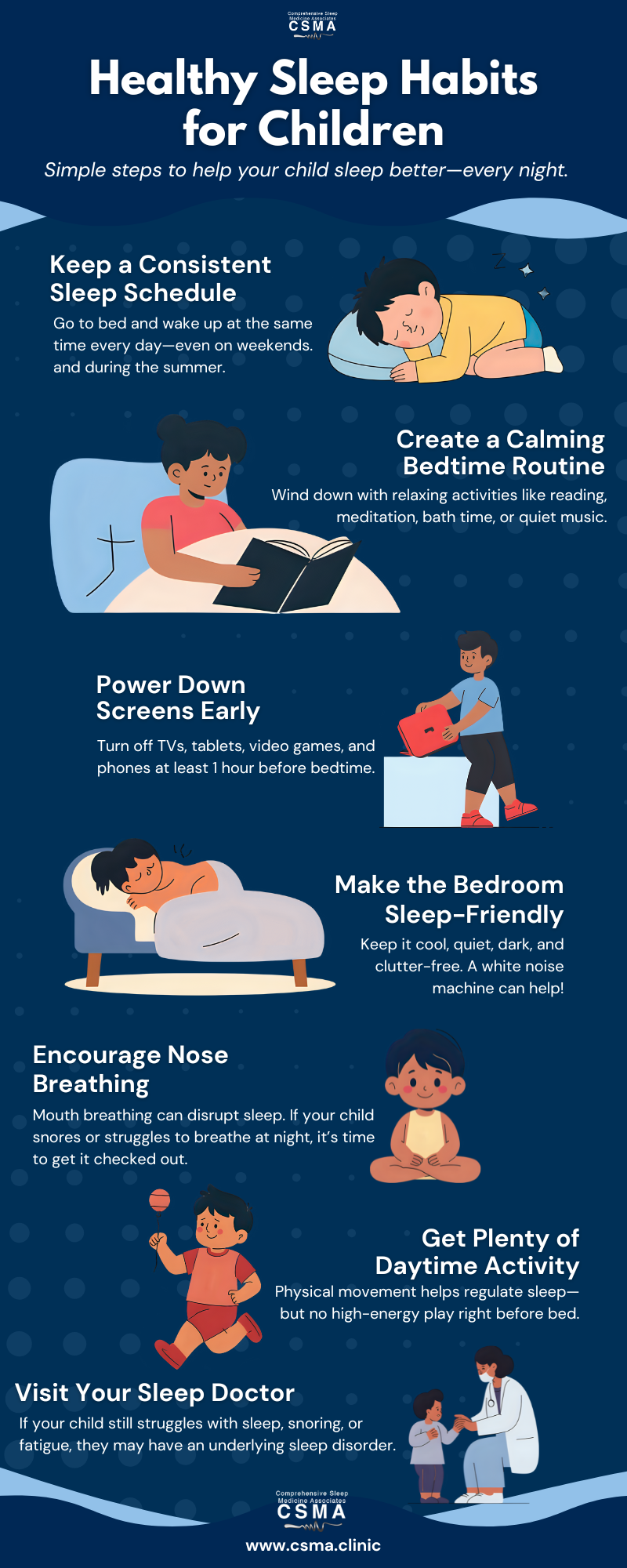
Establish a consistent schedule: Set regular bedtimes and wake times, including on weekends. Large differences between weekday and weekend schedules can make Monday mornings especially difficult.
Create a predictable bedtime routine: A calm sequence, such as bathing, brushing teeth, reading, and turning out the lights, helps the brain recognize that it is time to sleep.
Set an evening media curfew: Phones, tablets, televisions, and gaming devices can delay bedtime and keep the brain alert. Consider turning off screens at least one hour before bed and charging devices outside the bedroom.
Make the bedroom sleep-friendly: Keep the room cool, quiet, comfortable, and dark. The bed should be associated with sleep rather than homework, gaming, or scrolling through social media.
Watch caffeine intake: Coffee is not the only source of caffeine. Energy drinks, sodas, tea, chocolate, and some medications may interfere with sleep, particularly when consumed later in the day.
Track sleep and daytime symptoms: For one or two weeks, record bedtime, estimated sleep time, awakenings, snoring, morning symptoms, mood, and school concerns. This information can be helpful during a medical evaluation.
These changes can improve sleep when habits or schedules are the primary issue. But if symptoms continue despite a healthy routine, the problem may require more than an earlier bedtime.
When to Consider a Pediatric Sleep Evaluation
It may be time to speak with a sleep specialist if your child:
Snores loudly or frequently
Gasps, chokes, or pauses while breathing during sleep
Breathes through their mouth at night
Has persistent difficulty falling or staying asleep
Experiences recurring morning headaches
Grinds their teeth
Sleeps restlessly or wakes frequently
Is extremely difficult to wake
Falls asleep during school or other daytime activities
Continues to have concentration, behavior, or mood concerns
Experiences a decline in academic performance
Remains tired despite apparently getting enough sleep
Families looking for help with sleep disorders in Houston, TX do not have to keep guessing. A comprehensive pediatric sleep evaluation can help identify what is happening at night and how it may be affecting the child during the day.
Depending on the child’s symptoms, medical history, and sleep patterns, a specialist may recommend behavioral changes, further evaluation, or an overnight pediatric sleep study. Not every child requires the same testing or treatment, which is why individualized care matters.
Give Your Child the Best Possible Advantage
School success depends on many factors, but healthy sleep provides the foundation children need to focus, remember, manage emotions, and perform at their best.
At Comprehensive Sleep Medicine Associates, the pediatric sleep team evaluates children experiencing snoring, sleep apnea, insomnia, restless sleep, excessive daytime sleepiness, concentration concerns, and other sleep-related symptoms. CSMA takes a comprehensive approach to understanding the connection between nighttime sleep and daytime health.
If your child is struggling with attention, energy, mood, behavior, morning headaches, or school performance, do not assume it is laziness or something they will simply outgrow. An underlying sleep problem may be creating an obstacle they cannot overcome on their own.

Contact CSMA today to schedule a pediatric sleep evaluation. Helping your child achieve healthier, more restorative sleep could give them one of the most valuable advantages possible—for their health, their education, and their future.
Frequently Asked Questions Sleep and Academic Performance
Can lack of sleep cause poor grades?
Insufficient or disrupted sleep can contribute to problems with attention, memory, organization, emotional control, and mental alertness. These difficulties can make learning and completing schoolwork harder. Poor sleep is not the only possible cause of declining grades, but it is an important factor to consider.
Can a sleep disorder look like ADHD?
Yes. In some children, inadequate sleep may appear as hyperactivity, impulsivity, forgetfulness, irritability, or difficulty concentrating. ADHD and sleep disorders may also occur together, so a comprehensive evaluation is important rather than assuming one condition explains every symptom.
Is snoring normal in children?
Occasional snoring during a cold may not indicate a serious problem. Loud, frequent, or habitual snoring is not something parents should ignore, particularly when it occurs with gasping, breathing pauses, mouth breathing, restless sleep, or daytime problems.
Why does my child wake up with a headache?
Morning headaches can have many possible causes, including dehydration, teeth grinding, migraines, poor-quality sleep, and sleep-related breathing problems. Recurring headaches should be discussed with a healthcare professional, especially when accompanied by snoring, fatigue, or concentration difficulties.
How do I know if my child is getting enough sleep?
Consider both the number of hours slept and how your child functions during the day. Difficulty waking, daytime sleepiness, irritability, hyperactivity, frequent naps, concentration problems, and reliance on sleeping late during weekends may indicate that your child is not receiving enough restorative sleep.
Will my child need an overnight sleep study?
Not necessarily. A pediatric sleep specialist will first review your child’s symptoms, health history, sleep schedule, and nighttime behaviors. If a sleep-related breathing disorder or another condition is suspected, an overnight sleep study may be recommended to gather more information.
When should I contact CSMA?
Consider contacting CSMA when sleep problems persist despite healthy bedtime routines or when your child experiences frequent snoring, breathing pauses, excessive daytime sleepiness, recurring morning headaches, restless sleep, concentration difficulties, behavior changes, or declining school performance.


Comments